
This site provides general eye-health education. It cannot replace individual assessment by a registered doctor, and does not offer personal diagnosis, prescriptions, bookings, sales or referrals.
If translations differ or are incomplete, the Traditional Chinese (zh-Hant) text on this site prevails.
Drag the target power to compare far, intermediate and near. Optical illustration only — it cannot predict your post-operative vision and does not recommend any lens brand.
Optical design
Clearest at the targeted distance. Emmetropia: distance clear, near usually needs readers; myopic target reverses that. Night halos usually fewer than diffractive multifocals, still pupil- and surface-dependent.
Monofocal / target power
0.00 D · 正視 0 度
From hyperopia +3.00 (under-powered lens) to myopia −3.00 (near bias). Steps of 0.25 D (25 degrees). Multifocals usually aim for emmetropia; offset shifts every focus together.
Corneal astigmatism (toric)
0.00 D
Astigmatism stretches blur in one meridian — not the same as far vs near. For regular corneal astigmatism of about ≥0.75–1.00 D, a doctor may discuss a toric lens on monofocal, enhanced monofocal, EDOF or multifocal platforms. Lens rotation reduces the correction.
Depth-of-focus sketch

Bus 112

Badminton Open
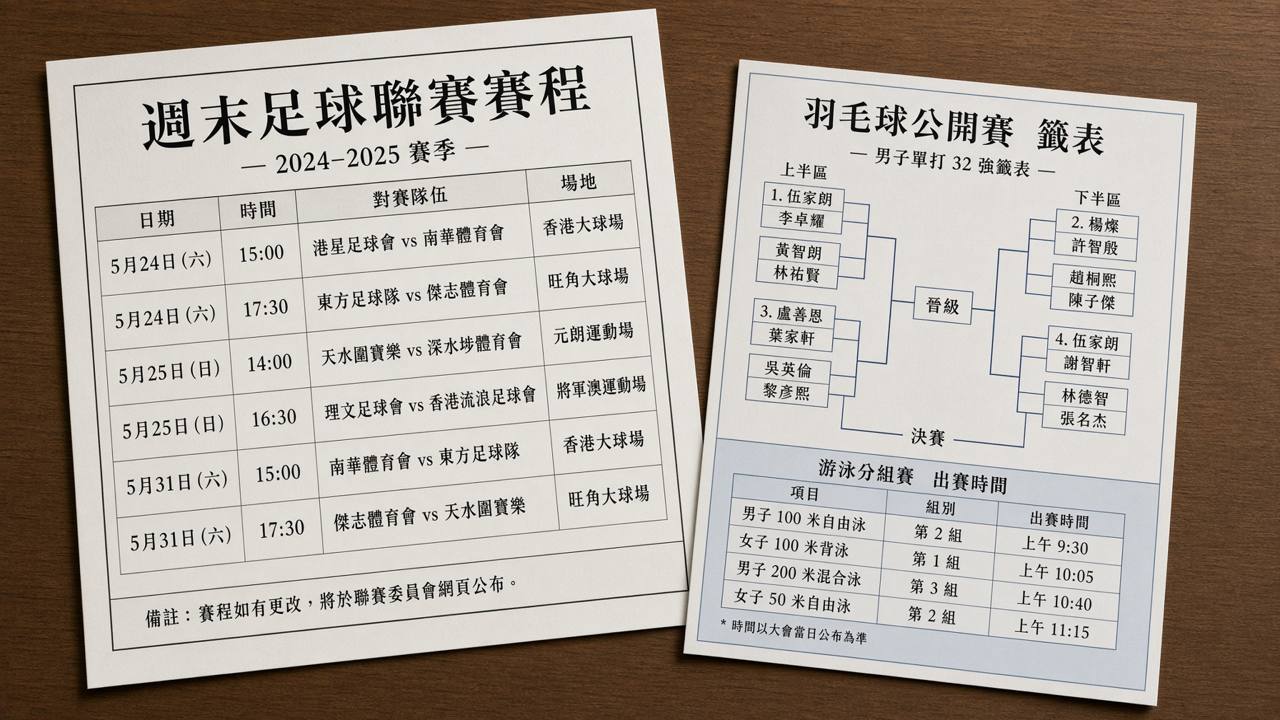
Sunday fixtures
How to read this demo
- Monofocal target emmetropia 0: distance is usually clearest; mid-distance news and near schedules often need readers.
- Monofocal target myopia −3.00: reading at about 33 cm is easier; distant signs are very blurry. −2.00 is about 50 cm. Some people use mini-monovision (one eye distance, one mildly near) — individual discussion.
- Monofocal target hyperopia +3.00: neither far nor near is in focus — an under-powered demo, not a usual target. +2.00 is similarly soft both ways, milder.
- Enhanced monofocal: intermediate often a bit better than standard monofocal; fine print usually still needs glasses.
- EDOF: far-to-intermediate more continuous; fine print often still needs glasses; night halos vary by design.
- Multifocal / trifocal: tries far, intermediate and near; contrast may drop a little; night halos more noticeable. Not for everyone and not a surgical promise.
Often discussed together
Factors commonly raised in cataract / IOL discussions, to read alongside this illustration. Not prescribing, not a surgical promise, and not a substitute for seeing a registered doctor.
Dry eye and post-operative visual quality
An unstable tear film makes the corneal surface less smooth, lowering contrast and increasing glare — vision can feel “not crisp” even when sphere and cylinder are corrected. Severe or difficult dry eye may make doctors cautious about multifocal or extended-depth designs. This page does not simulate dry eye separately, but tear-film care still affects real-world quality.
Dry-eye topic →Why the dominant (sighting) eye matters
The dominant eye is the one the brain tends to prefer when both eyes are open, especially for aligning on a distant target or fine detail. When monovision or different powers are planned, which eye carries the main distance can affect adaptation and satisfaction. This page shows one target-power setting at a time and cannot measure which eye is dominant.
The dominant eye is not the same as hand dominance. It is the eye you more often use as a visual reference for alignment and focus. Doctors consider it when planning monovision or a main-distance eye — self-checks cannot replace dilated refraction or prescribing.
Home self-checks (illustration, not a diagnosis)
- Miles triangle: extend your arms, form a small triangle with thumbs and index fingers, and centre a distant target (~3 m). Close one eye at a time — the eye that still keeps the target centred is usually the sighting-dominant eye. Repeat; results can vary slightly.
- Dolman hole-in-card: with both eyes open, centre a small hole in a card on a fixed target about 3 m away; while keeping alignment, note which eye still sees the target through the hole — that eye is often dominant. Repeat a few times.
These checks are for understanding only — not a substitute for dilated refraction, clinical choice of the main-distance eye, or a surgical promise.
Monovision / mini-monovision
Monovision deliberately sets one eye toward distance and the other toward intermediate or near (or mild myopia), relying on binocular fusion to reduce spectacle wear. Mini-monovision usually means a smaller inter-eye difference (follow your doctor). Trade-offs can include changed stereo / depth cues, discomfort in some people, and adaptation time; trial frames or contact trials and medical planning are required. The slider here illustrates one eye’s target only, not binocular fusion.
Halos, rings and other optical effects (multifocal / extended depth)
Diffractive multifocal / trifocal designs split light among several foci — daytime contrast may drop a little, and rings or halos around point lights are easier to notice at night (try the “Night halos” button on this page). Extended depth (EDOF) halos are usually softer, but contrast can still fall a little and night effects vary by design and pupil. Spectacles can correct residual sphere and cylinder, but design-related contrast loss and night halos are usually not removed by glasses. See the multifocal screening topic and the night-halo comparison tool; this page is not a measurement or ranking.
Illustration / self-check cannot replace dilated fundus exam, visual field or OCT. A normal tool result cannot rule out disease. Not a post-operative guarantee. This site does not book or refer.